Loading
Healthcare · Case Study
Hoag Health System: Social Media Strategy — fewer posts, greater impact.
IndustryHealthcare
EngagementBrand Architecture + Content Systems
ScopeEnterprise Social
The situation
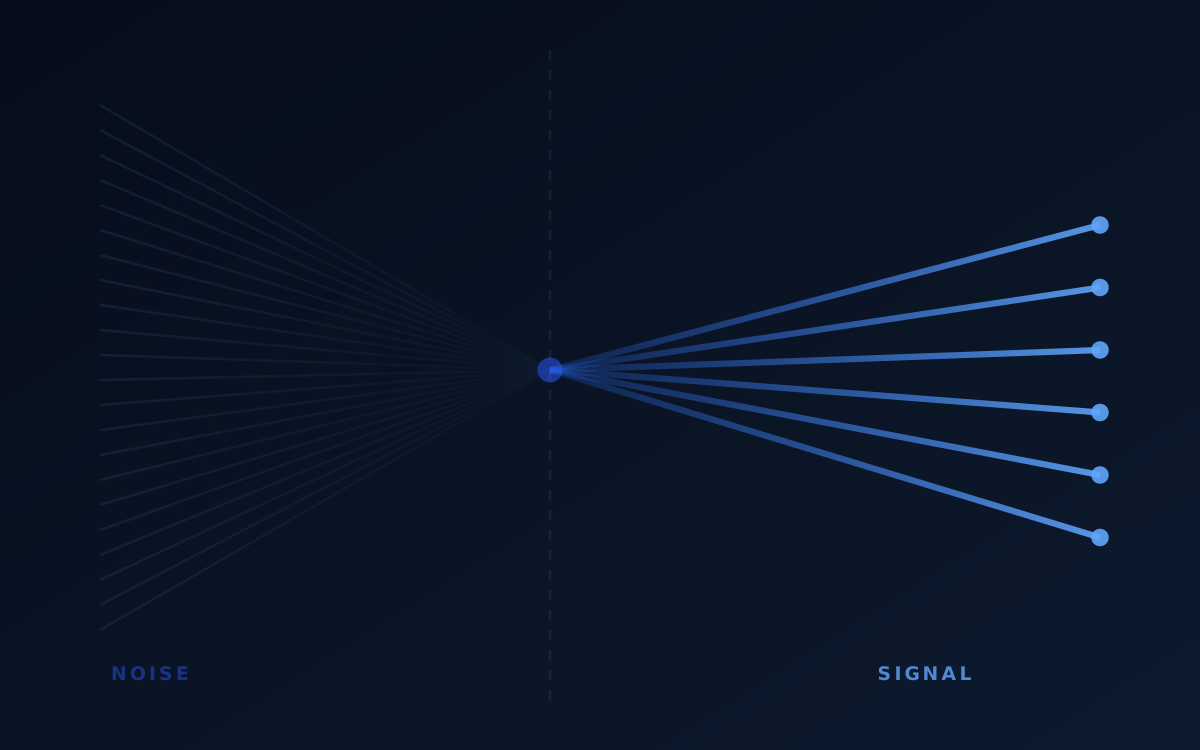
A noisy feed. A strong brand. No system connecting the two.
When I joined Hoag in late 2024, the social program was active. Posts went out regularly. Campaigns ran on schedule. But the feed didn’t feel like Hoag. It felt like a content calendar doing its job.
The audit made it clear quickly: the problem wasn’t effort. It was architecture. There was no framework deciding what belonged in the feed, what audience it was for, what it was supposed to make them feel or do. Content was being created to fill space rather than earn it.
The opportunity was to build that architecture from the foundation, and then see what happened when every piece of content had a job.
How it was built
Less content. More intention.
01
The audit
The work started with an honest look at what existed. Every platform, every content type, every post frequency examined against one question: is this earning its place in the feed? Most of it wasn’t. The system wasn’t broken because people weren’t working hard. It was broken because there was no architecture deciding what belonged.
02
Quality content by design
What emerged was a framework built around discernment, not volume. Each idea was filtered through three questions: what’s the story worth telling? Does it meet a moment that matters? Can it be brought to life in a way that earns attention rather than demands it? From there, content verticals took shape that mirrored Hoag’s actual voice: education, storytelling, and inspiration.
03
Platform-specific strategy
Each platform got its own purpose. Content was designed for the audience actually on it, tied to quarterly calendars aligned with business priorities. Physicians, staff, and patients were united under one cohesive narrative. And every piece was designed to feel local: the rhythm of Orange County’s coastal communities, a balance of ambition and ease, precision and warmth.
04
Fewer moves, greater movement
Cutting volume by 70% was the counterintuitive bet. It meant saying no to a lot of content that was being created just to fill the calendar. What replaced it was smaller in quantity and far heavier in impact. Each post was chosen, not scheduled. The results reflected that shift almost immediately.
The results
What happens when every post has a reason to exist.
By mid-2025, the feed felt different. Each post carried weight. Impressions per post climbed 169%. Engagement per post rose 154%. Video views per post grew 498%. And all of it happened while posting 70% less.
The Orange County community started showing up in the content. Physicians, staff, and patients appeared in a feed that felt like it was made for the people scrolling through it, because it was. Local in tone. Clear in purpose. Consistent in voice.
The counterintuitive lesson that runs through all of this: in a feed that rewards relevance over volume, doing less is often the most impactful move available.
−70%
Post volume
+169%
Impressions per post
+154%
Engagement per post
+498%
Video views per post
Before
High volume, low signal. Content to fill the calendar.
The shift
A framework built around discernment. Every post earns its place.
The feed
Local in tone. Purpose-driven. Unified across physicians, staff, and patients.
The proof
+169% impressions per post while posting 70% less.
The lasting principle
The system that made it scale.
The Hoag engagement proved something that applies broadly to any brand in a trust-driven industry: audiences are not rewarded by volume. They are rewarded by relevance. The more a brand tries to be everywhere all the time, the less it feels like it belongs anywhere in particular.
What the framework built here was a repeatable system for deciding what belongs. Not a content calendar. A content philosophy. Each pillar feeding the others: education that positioned Hoag as a leader, storytelling that made complex care feel human, and inspiration that reminded the community why it all mattered.
The framework was designed to hold its shape and also to bend. As new campaigns, physicians, and real-world stories emerged, the system adapted without losing its architecture. That is the mark of a content system that actually works: it gets stronger as more runs through it.
The methodology is the same one I bring to every engagement. Find what’s worth saying. Build the system that carries it. Post less. Mean more.
Common Questions
What people usually ask about this work.
How did Hoag increase impressions while posting 70% less?+
What does editorial governance look like in healthcare social media?+
Can a 'less is more' content strategy work for other health systems?+
Let’s Talk
Your story is probably closer than you think.
Let’s talk about what you’re working with and what it could become.