Loading
Healthcare · Case Study
City of Hope: Healthcare Content Strategy that earned national coverage.
IndustryHealthcare
EngagementBrand Architecture + Content Strategy
ScopeIntegrated Campaign
The situation
A nationally recognized cancer center, expanding into a new community.
City of Hope is one of the country’s leading cancer research and treatment centers. The Orange County campus represented an expansion into a new market, which meant building trust from the ground up with patients, caregivers, physicians, and community members who didn’t yet know what City of Hope stood for.
The existing social program had presence. What it needed was a framework that could carry the full weight of the institution: its clinical rigor, its research leadership, and the deeply human stories at the center of every patient journey.
The opportunity was clear. A mature program with real stories to tell, a community ready to listen, and a content system that hadn’t yet been designed to connect the two.
How it was built
A framework for credibility and connection.
01
The content framework
The work started with architecture. I developed an integrated content framework that could hold three distinct audiences at once: patients looking for care, caregivers seeking support, and the broader community building trust in a new institution. Each piece had to serve at least one, ideally more than one.
02
Clinical credibility meets human storytelling
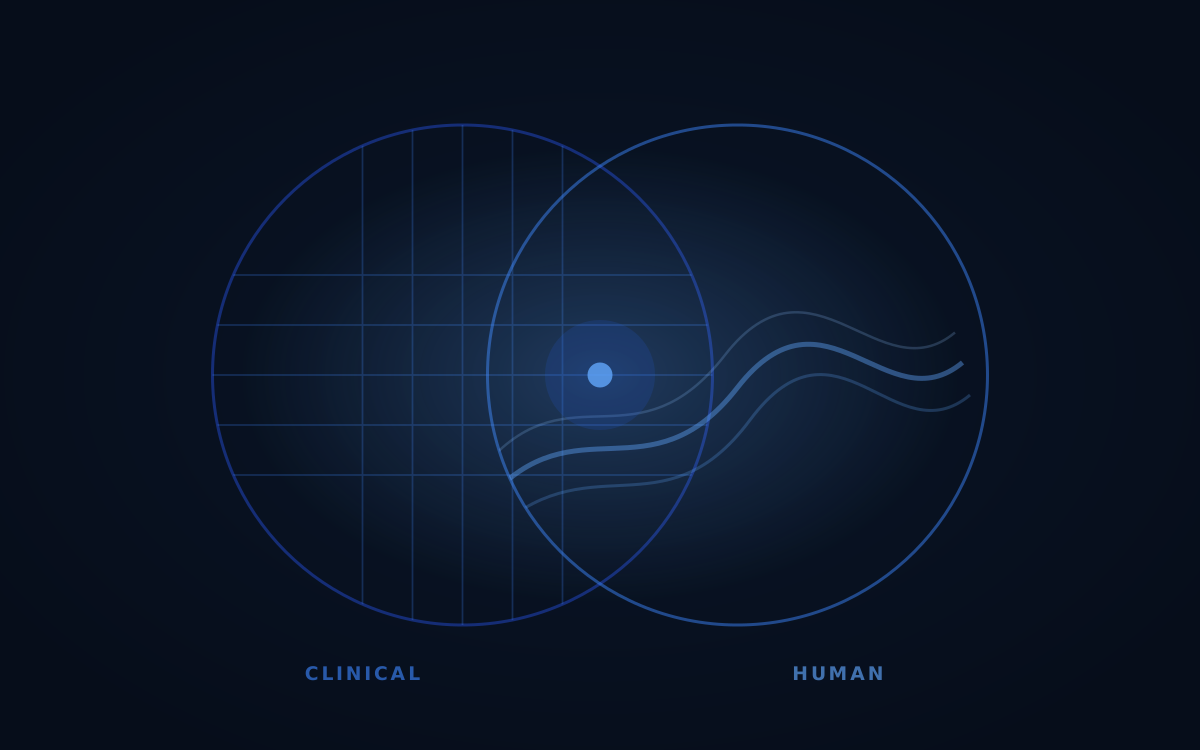
City of Hope carries serious clinical authority. The challenge was making that authority feel human without diluting it. The framework balanced hard medical credibility, physician expertise, and research leadership on one side, with patient stories, caregiver experiences, and community warmth on the other.
03
Video and high-intent content
The program was rebuilt around video and high-intent content formats. Traffic from social tripled. Video reach more than doubled. The shift was less about production volume and more about deliberate format selection. Every asset had a job, and it was chosen accordingly.
04
From presence to performance
The results reflected the shift in philosophy. A mature social program that had built its presence over years was now being asked to perform. Impressions climbed 41%. Link clicks surged 223%. The program went from presence to performance, without adding headcount or budget.
The story that became national news
One story. Multiple formats. Every channel.
A fire chief arrived for his final chemotherapy session, unaware that dozens of colleagues, friends, and family members were waiting to greet him. What began as a simple idea to honor one patient grew into something much larger.
Creative partners, media teams, and hospital staff worked in quiet sync to make the moment matter. The coordination was invisible. The result was not. The story became national coverage on ABC World News Tonight, reaching an audience that no paid campaign could have assembled.
That story didn’t happen by accident. It happened because a content system was already in place that knew how to find it, frame it, and carry it into every channel and format that mattered.
ABC
News national coverage
+58%
Reach and engagement
The idea
A simple act of recognition for a patient completing treatment
The coordination
Creative partners, media teams, and hospital staff working together
The moment
Dozens of people waiting when he walked through the door
The reach
ABC World News Tonight. National audience. Organic.
“One narrative. Multiple formats. Audiences across every channel. The system at work.”
The lasting impact
Presence became performance.
The results reflected the shift in philosophy. Impressions climbed 41%. Link clicks surged 223%. Reach and engagement grew 58% overall. The program went from presence to performance, without adding headcount or budget.
But the number that mattered most wasn’t in a dashboard. It was a fire chief walking through a door to find his community waiting, and a camera ready to capture it because the system knew that was exactly the kind of story worth telling.
The framework built at City of Hope proved something that applies across every industry where trust is the product: clinical authority and human warmth are not in tension. They compound each other when the content system is designed to carry both.
That is the methodology. Find the real story. Build the system that carries it. Let it travel to every audience that needs to hear it, in every format that makes it land.
Common Questions
What people usually ask about this work.
How did City of Hope increase link clicks by 223%?+
How do you handle compliance in healthcare content?+
What results can a healthcare system expect from a content overhaul?+
Let’s Talk
Your story is probably closer than you think.
Let’s talk about what you’re working with and what it could become.